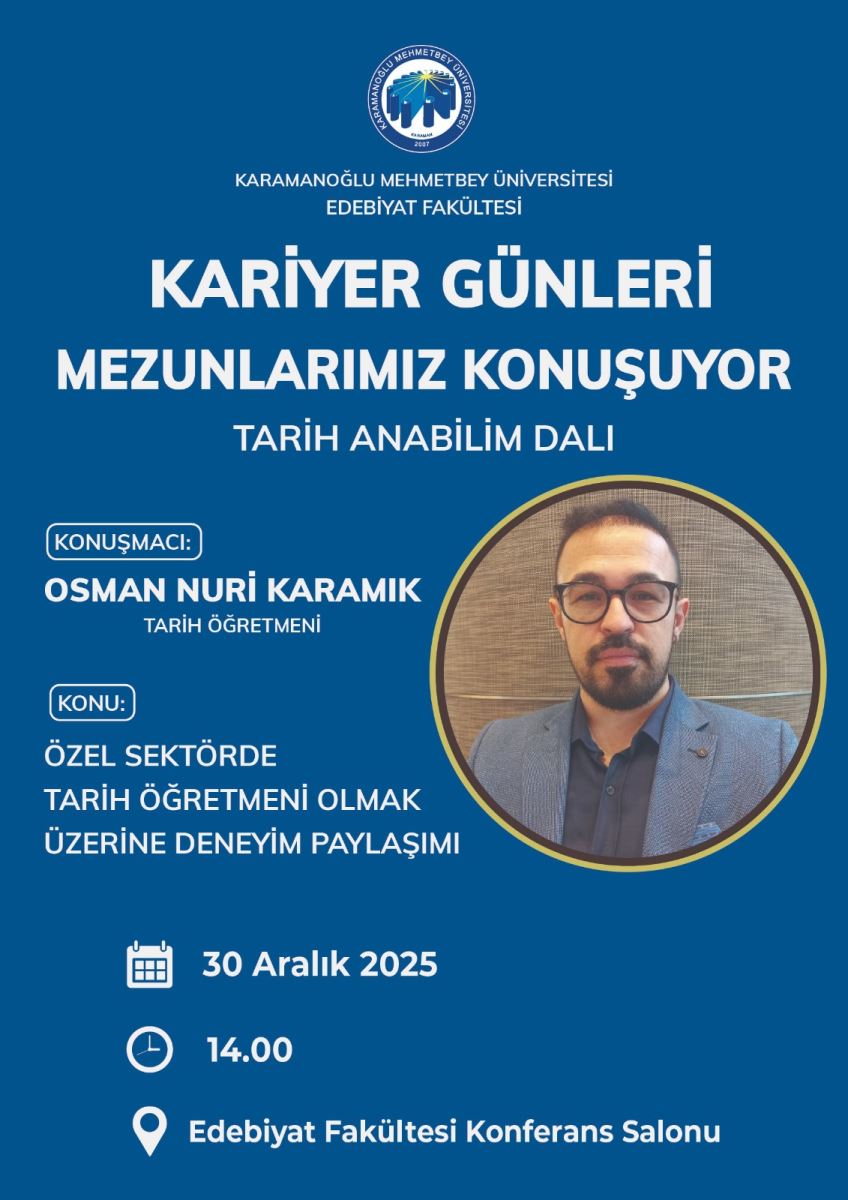
Experience Sharing by Our Alumni on Being a History Teacher in the Private Sector
Tarih: 30 Aralık 2025
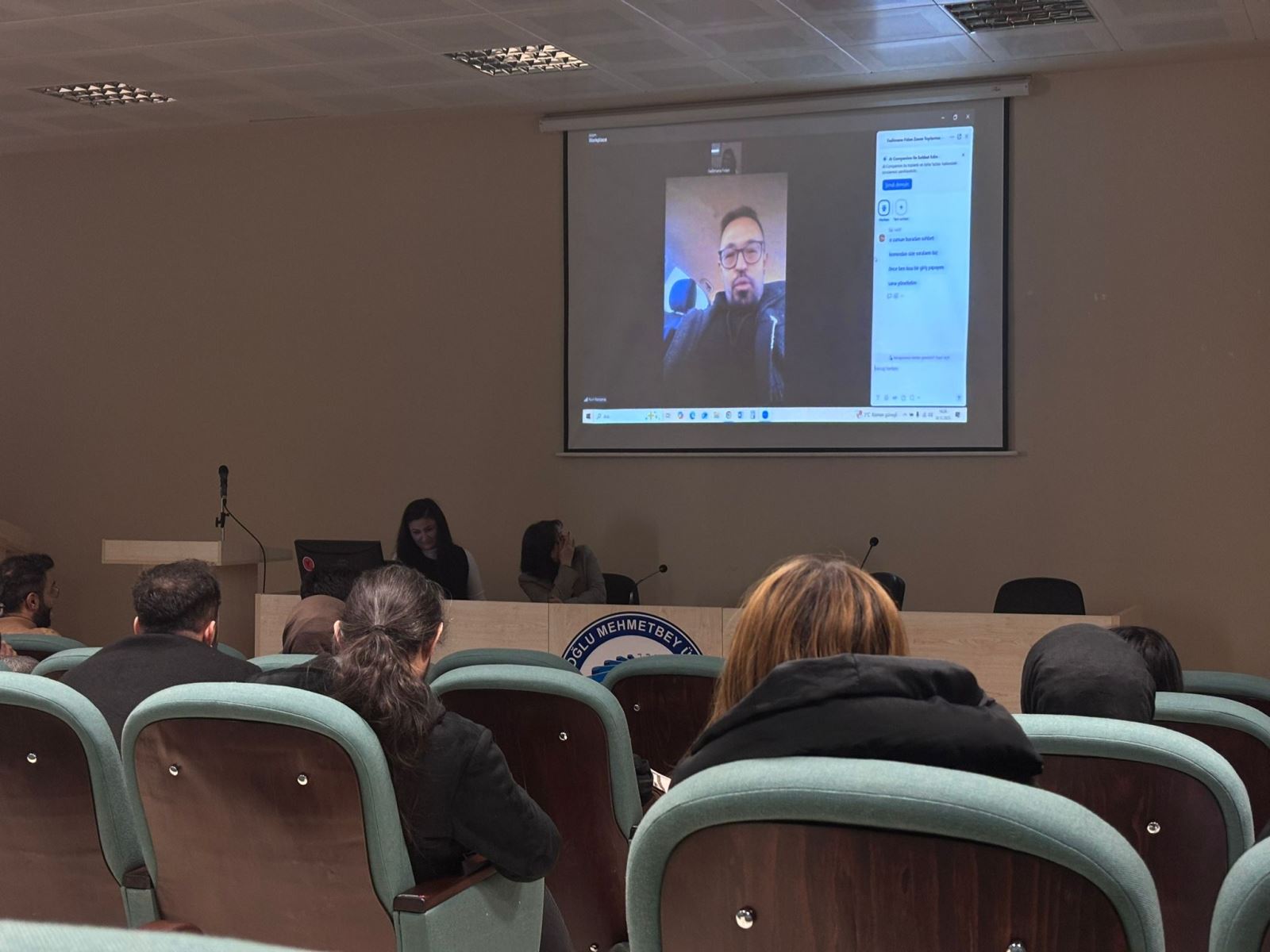
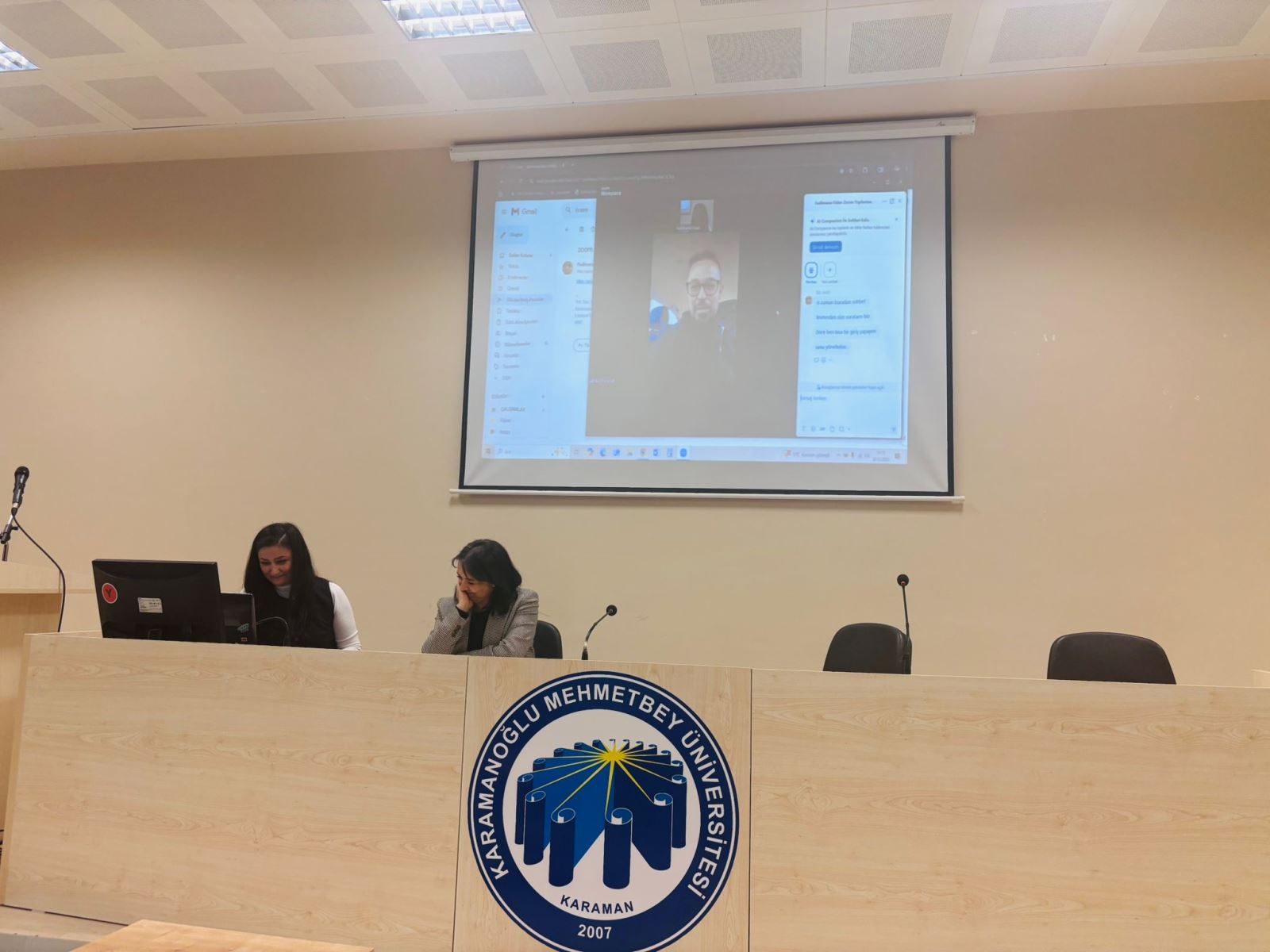
Within the scope of activities carried out by the Graduation, Alumni Guidance, and Career Planning Commission of the Department of History at Karamanoğlu Mehmetbey University (KMÜ), 2015 graduate Osman Nuri Karamık delivered a talk titled “Experience Sharing on Being a History Teacher in the Private Sector.”
During the event, Karamık provided a comprehensive account of his professional experiences in private educational institutions and KPSS preparatory courses. He stated that working as a history teacher in the private sector offers satisfactory financial returns, emphasizing that a daily wage model is commonly applied and that the sector presents notable advantages in terms of material income. He further highlighted that while unionization does exist in the private sector, working conditions can be challenging, and trade unions play a vital role as key support mechanisms for the protection of professional rights. Karamık also noted that he completed pedagogical formation training after graduation and sat for the KPSS examination but was not successful in securing a passing score. Despite this, he expressed that being a sought-after professional in the private sector provides a strong source of moral satisfaction and professional motivation.
Karamık also shared insights from his work experience in multiple cities, including Osmaniye, Adana, and Karaman, before eventually returning to his hometown. He remarked that he had explored different career paths prior to fully committing to the teaching profession but found none as fulfilling, summarizing the personal significance of his career choice by stating, “My greatest moral satisfaction has been practicing the profession for which I was trained.” He drew particular attention to Türkiye’s need for individuals with academic expertise in history and professional historians, underscoring that serving in this field carries both social responsibility and intrinsic value.
He additionally pointed out that working hours in private educational institutions are generally long and that policies regarding medical leave reports vary between institutions—some require official health documentation, while others do not. Karamık noted that both institutions and students recognize the importance of history as a discipline and value the professional identity of historians, acknowledging that educators from other subject areas cannot provide the same level of disciplinary competence. He further emphasized that history graduates are in high demand, particularly in KPSS preparatory courses, and stated that he currently provides KPSS history instruction while continuing his professional role at a private educational institution.
Reflecting on his undergraduate years, Karamık admitted that he had not fully appreciated the importance of departmental training during his bachelor’s studies but later realized the decisive role of academic foundation after graduation. He advised senior students on the necessity of gaining practical experience—through activities such as question-solving sessions, invigilation, and supervisory roles in preparatory courses—drawing attention to the importance of early professional practice with the remark, “I wish I had started this process earlier.” He also stated that even small gestures from students, such as celebrating a teacher’s special day, provide profound moral fulfillment, and stressed that in history teaching, moral satisfaction often surpasses material gain as the primary sustaining force of the profession.
Offering guidance on career planning, Karamık remarked that students initially tend to aspire to professions such as becoming military officers or police personnel but emphasized that the private education sector should be considered a strong priority, especially for history educators. He encouraged graduates and prospective teachers to become members of trade unions associated with private education, explaining that these organizations provide institutional support regarding working hours and wage policies. He further urged alumni, “Do not work for low wages; seek and defend your rights,” and recommended that students pursue employment opportunities within more corporate and institutionally established educational companies.
Karamık also stated that, due to the high frequency of history-based questions in the KPSS examination, undergraduate students should place greater academic emphasis on Ottoman History courses, recommending that “Ottoman History classes should be prioritized more extensively in the curriculum.” He concluded his speech with the message, “Our country needs individuals who possess strong historical knowledge—make the most of this demand and opportunity.”
The event was evaluated as a significant professional engagement platform, enabling KMÜ History students to gain insight into both the material and moral dimensions of history teaching in the private sector and KPSS preparatory institutions, while reinforcing the value of alumni-student interaction for career planning and professional awareness. The Graduation, Alumni Guidance, and Career Planning Commission of the KMÜ Department of History announced that similar events aiming to strengthen alumni-student collaboration, guide career planning processes, and enhance professional awareness will continue in future academic terms. Commission representatives reiterated that experience-sharing sessions focusing on the private sector, public examinations, and academic career pathways contribute substantially to students’ professional development, and emphasized that new alumni engagements will be sustained with similar thematic content in the upcoming periods.
Okunma sayısı: 260 kez okundu